Do you want to live in a world where plants and animals are the same everywhere you go? Are there things that the diversity of life on Earth does for humanity that are irreplaceable? Do you feel that it is acceptable for humans to push out other forms of life on our planet? In other words, do plants and animals have a right to live undisturbed by us? Do plants and animals, or ecosystems, have rights at all?
This is the link to the article that you will be responding to.
Problem: Extinction Of Plant And Animal Species
http://www.webofcreation.org/Earth%20Problems/species.htm
Remember, you need to write a 300 word opinion/reaction to the article by Friday, July 29. You then have between Friday, July 29 and Friday, August 5 to respond to one of your classmate's posts. Please see the calendar page, the link for which is on the right.
Additionally, you should take a look at the links below to familiarize yourself with the issue a bit more. This will give you some context when you read the article. I don't expect you to spend too much time, but take a few minutes to explore the sites and get an idea for the scope of the issue.
What is biodiversity and why is it important? Short explanation.
http://www.ciel.org/Biodiversity/WhatIsBiodiversity.html
Services the diversity of life provides humans. There is also a lot of other great information on this page.
http://www.globalissues.org/article/170/why-is-biodiversity-important-who-cares#Ahealthybiodiversityoffersmanynaturalservices
This site has a great interactive map showing places in the world where biodiversity is most threatened. Open the map and explore.
http://www.biodiversityhotspots.org/Pages/default.aspx
This is from the same site as the interactive map, but is the page for the Central America region. You should definitely check it out!
http://www.biodiversityhotspots.org/xp/Hotspots/mesoamerica/Pages/default.aspx
Thursday, July 21, 2011

Friday, July 15, 2011
Article 6 - Hazardous Chemicals In The Environment - Biomagnification
How much is too much of any particular pollutant? Are there some pollutants that are unsafe at any concentration? What factors need to be accounted for when setting limits on how much of a pollutant will be allowed?
This is the link to the article that you will be responding to.
Mercury In The Environment
http://www.usgs.gov/themes/factsheet/146-00/
Remember, you need to write a 300 word opinion/reaction to the article by Friday, July 22. You then have between Friday, July 22 and Friday, July 29 to respond to one of your classmate's posts. Please see the calendar page, the link for which is on the right.
Additionally, you should take a look at the links below to familiarize yourself with the issue a bit more. This will give you some context when you read the article. I don't expect you to spend too much time, but take a few minutes to explore the sites and get an idea for the scope of the issue.
A definition and diagram showing how biomagnification occurs.
http://wblrd.sk.ca/~sci10_dev/1_ecosystems/biomag.html
What is mercury and where does it come from?
http://www.uwec.edu/jolhm/EH/Leslie/what_mercury.htm
This link is for a calculator that will tell you if the amount of fish you eat contains too much mercury.
http://www.gotmercury.org/article.php?list=type&type=75
A map showing US mercury pollution.
http://whyfiles.org/201mercury/images/hg_deposition.gif
A fascinating article about shortages of important rare elements used in all of our favorite gadgets. Why you should recycle your old electronics.
http://thenextweb.com/insider/2011/06/19/why-your-favorite-gadgets-are-threatening-the-planets-future/
This is the link to the article that you will be responding to.
Mercury In The Environment
http://www.usgs.gov/themes/factsheet/146-00/
Remember, you need to write a 300 word opinion/reaction to the article by Friday, July 22. You then have between Friday, July 22 and Friday, July 29 to respond to one of your classmate's posts. Please see the calendar page, the link for which is on the right.
Additionally, you should take a look at the links below to familiarize yourself with the issue a bit more. This will give you some context when you read the article. I don't expect you to spend too much time, but take a few minutes to explore the sites and get an idea for the scope of the issue.
A definition and diagram showing how biomagnification occurs.
http://wblrd.sk.ca/~sci10_dev/1_ecosystems/biomag.html
What is mercury and where does it come from?
http://www.uwec.edu/jolhm/EH/Leslie/what_mercury.htm
This link is for a calculator that will tell you if the amount of fish you eat contains too much mercury.
http://www.gotmercury.org/article.php?list=type&type=75
A map showing US mercury pollution.
http://whyfiles.org/201mercury/images/hg_deposition.gif

A fascinating article about shortages of important rare elements used in all of our favorite gadgets. Why you should recycle your old electronics.
http://thenextweb.com/insider/2011/06/19/why-your-favorite-gadgets-are-threatening-the-planets-future/
Friday, July 8, 2011
Article 5 - Renewable Energy - Solar
How do we decide what environmental impacts are acceptable? Who gets to decide where those impacts will be felt? How does our society justify an environmental impact in one place and of one type, to offset an impact of a different type elsewhere?
This is the link to the article that you will be responding to.
State Solar Power Plans Are As Big As All Outdoors
http://articles.latimes.com/2008/dec/03/business/fi-bigsolar3
Remember, you need to write a 300 word opinion/reaction to the article by Friday, July 15. You then have between Friday, July 15 and Friday, July 22 to respond to one of your classmate's posts. Please see the calendar page, the link for which is on the right.
Additionally, you should take a look at the links below to familiarize yourself with the issue a bit more. This will give you some context when you read the article. I don't expect you to spend too much time, but take a few minutes to explore the sites and get an idea for the scope of the issue.
Radio discussion about solar power in California about 20 minutes long. Click on the link and go to time 34:30 to listen to the discussion.
http://www.kcrw.com/media-player/mediaPlayer2.html?type=audio&id=ww081203controversy_over_sol
All forms of power production have an environmental impact.
http://solar.calfinder.com/blog/solar-politics/californias-renewable-energy-zones-raise-fresh-controversy/
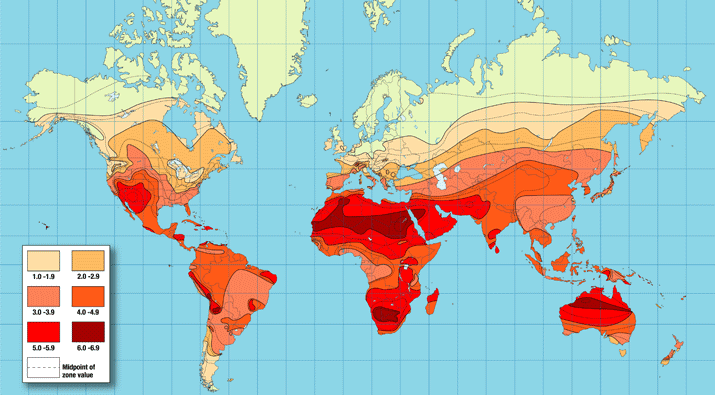
This link is for a map of the United States showing how much solar energy is available.
http://www.bluechipenergy.org/images/US-PV-Solar-Resouce-Map_600px-clean.jpg
This is a similar map for the entire world.
http://www.oksolar.com/abctech/images/world_solar_radiation_large.gif
This is the link to the article that you will be responding to.
State Solar Power Plans Are As Big As All Outdoors
http://articles.latimes.com/2008/dec/03/business/fi-bigsolar3
Remember, you need to write a 300 word opinion/reaction to the article by Friday, July 15. You then have between Friday, July 15 and Friday, July 22 to respond to one of your classmate's posts. Please see the calendar page, the link for which is on the right.
Additionally, you should take a look at the links below to familiarize yourself with the issue a bit more. This will give you some context when you read the article. I don't expect you to spend too much time, but take a few minutes to explore the sites and get an idea for the scope of the issue.
Radio discussion about solar power in California about 20 minutes long. Click on the link and go to time 34:30 to listen to the discussion.
http://www.kcrw.com/media-player/mediaPlayer2.html?type=audio&id=ww081203controversy_over_sol
All forms of power production have an environmental impact.
http://solar.calfinder.com/blog/solar-politics/californias-renewable-energy-zones-raise-fresh-controversy/
This link is for a map of the United States showing how much solar energy is available.
http://www.bluechipenergy.org/images/US-PV-Solar-Resouce-Map_600px-clean.jpg

This is a similar map for the entire world.
http://www.oksolar.com/abctech/images/world_solar_radiation_large.gif
Saturday, July 2, 2011
Article 4 - Rangelands - Desertification
What effect does human land use have on the climate/weather? Is it all about tropical rain forests? Or are there other vulnerable regions? What are some other regions closer to the tipping point, where a small increase in human activities can cause instability in the climate/weather?
This is the link to the article that you will be responding to.
Desertification - A Threat To The Sahel
http://www.eden-foundation.org/project/desertif.html
Remember, you need to write a 300 word opinion/reaction to the article by Friday, July 8. You then have between Friday, July 8 and Friday, July 15 to respond to one of your classmate's posts. Please see the calendar page, the link for which is on the right.
Additionally, you should take a look at the links below to familiarize yourself with the issue a bit more. This will give you some context when you read the article. I don't expect you to spend too much time, but take a few minutes to explore the sites and get an idea for the scope of the issue.
A short article connecting the Dust Bowl in the United States to the Sahel region of Africa.
http://earthobservatory.nasa.gov/Features/DustBowl/
This is a nice, detailed map showing the worldwide vulnerability to desertification.
http://upload.wikimedia.org/wikipedia/commons/6/68/Desertification_map.png
This page gives some background on the Sahel region of Africa, with pictures and maps.
http://ponce.sdsu.edu/sahel_081015.html
This is the link to the article that you will be responding to.
Desertification - A Threat To The Sahel
http://www.eden-foundation.org/project/desertif.html
Remember, you need to write a 300 word opinion/reaction to the article by Friday, July 8. You then have between Friday, July 8 and Friday, July 15 to respond to one of your classmate's posts. Please see the calendar page, the link for which is on the right.
Additionally, you should take a look at the links below to familiarize yourself with the issue a bit more. This will give you some context when you read the article. I don't expect you to spend too much time, but take a few minutes to explore the sites and get an idea for the scope of the issue.
A short article connecting the Dust Bowl in the United States to the Sahel region of Africa.
http://earthobservatory.nasa.gov/Features/DustBowl/
This is a nice, detailed map showing the worldwide vulnerability to desertification.
http://upload.wikimedia.org/wikipedia/commons/6/68/Desertification_map.png

This page gives some background on the Sahel region of Africa, with pictures and maps.
http://ponce.sdsu.edu/sahel_081015.html
Subscribe to:
Posts (Atom)